
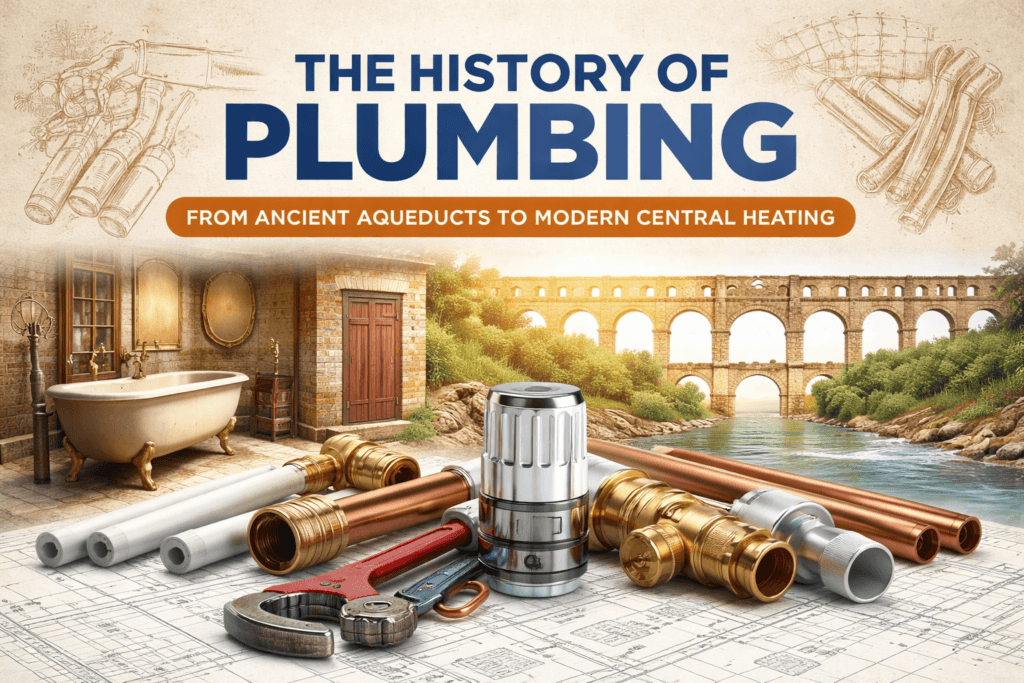
From Ancient Aqueducts to Modern Central Heating
Plumbing is one of those everyday essentials we rarely think about—until something stops working. Yet the history of plumbing is a fascinating story of engineering, public health, and home comfort. From ancient clay pipes and Roman aqueducts to today’s efficient boilers and smart heating controls, plumbing has shaped how we live.
What Does “Plumbing” Actually Mean?
The word plumbing comes from the Latin plumbum, meaning lead. Early pipework was often made from lead because it was easy to shape. We now know lead can be harmful, and modern systems use safer materials such as copper and plastics—but the name stuck.
Early Plumbing in the Ancient World
Ancient Civilisations and the First Pipe Systems
Long before modern bathrooms, early civilisations created basic drainage and water supply systems. Archaeological evidence suggests that ancient societies used:
- Clay pipes and channels to move water
- Stone drainage to remove waste and stormwater
- Gravity-fed systems to deliver water across towns and cities
The Romans: The Big Leap Forward
When people think of ancient plumbing, they often think of the Romans—for good reason. Roman engineers built impressive public works such as:
- Aqueducts to transport fresh water over long distances
- Public baths with heated water systems
- Public fountains and communal water access
- Early sewer networks to improve sanitation
These systems were not just about comfort—they helped reduce disease by improving hygiene and water access.
Plumbing in Britain: From Roman Times to the Middle Ages
Roman infrastructure influenced parts of Britain while the Empire was present, but after the Romans left, much of that engineering knowledge and public infrastructure declined. During the Middle Ages, sanitation was limited and public health suffered as towns grew denser without reliable waste removal.
Water was often collected from wells, rivers, or shared pumps, and waste disposal could be rudimentary—one of the reasons outbreaks of disease were so common in crowded areas.
The Industrial Revolution: Plumbing Becomes Practical
The Industrial Revolution brought major progress. Cities expanded rapidly, and the need for safer water systems became unavoidable. Key developments included:
- Mass production of pipes (making plumbing more accessible)
- Improved sewer systems in growing towns and cities
- Better water treatment and cleaner supply networks
- Early indoor plumbing becoming more common in wealthier homes
As public understanding of disease improved, plumbing shifted from “nice to have” to essential for health and safety.
From Outdoor Toilets to Modern Bathrooms
Over time, indoor bathrooms became a standard feature in homes. Advances in materials and design made systems more reliable, including:
- Cast iron and copper pipes replacing older materials
- Traps and venting improving smell control and safety
- Pressurised mains water improving flow and consistency
- Hot water cylinders becoming a standard for domestic hot water
The Rise of Central Heating and Modern Boiler Systems
Plumbing isn’t just taps and toilets—modern plumbing is deeply connected to heating. The growth of central heating transformed home comfort, including:
- Radiator systems replacing open fires as the main heat source
- Gas boilers becoming common due to efficiency and convenience
- Combination boilers (combi) delivering hot water on demand
- Improved controls like programmable thermostats and smart heating
Today’s systems focus on efficiency, safety, and controllability—with magnetic filters, system protection, and wireless controls often playing a key role in modern installs.
Plumbing Today: Smarter, Safer, More Efficient
Modern plumbing has come a long way. Materials and standards have improved dramatically, and UK regulations ensure heating and plumbing work is completed safely. Typical modern upgrades include:
- Condensing boilers for improved efficiency
- Smart thermostats and zoning controls to reduce wasted heating
- Water efficiency improvements and better system balancing
- System protection with inhibitors and magnetic filtration
Why the History of Plumbing Still Matters
The reason plumbing keeps evolving is simple: it’s directly linked to health, safety, and comfort. Clean water and proper sanitation changed society. Efficient heating changed how we live in our homes. And as energy costs and environmental concerns rise, plumbing and heating will continue to innovate.
Need Help With Your Plumbing or Heating?
If you’re upgrading your boiler, improving your heating controls, or dealing with a plumbing issue, it helps to use a qualified professional.
For boiler installations, repairs, servicing, or heating upgrades, get in touch and we’ll point you in the right direction.
Contact us here or call Elliott on 07969 157520.